


Improving Subseasonal to Seasonal Precipitation Forecasting For Water Management
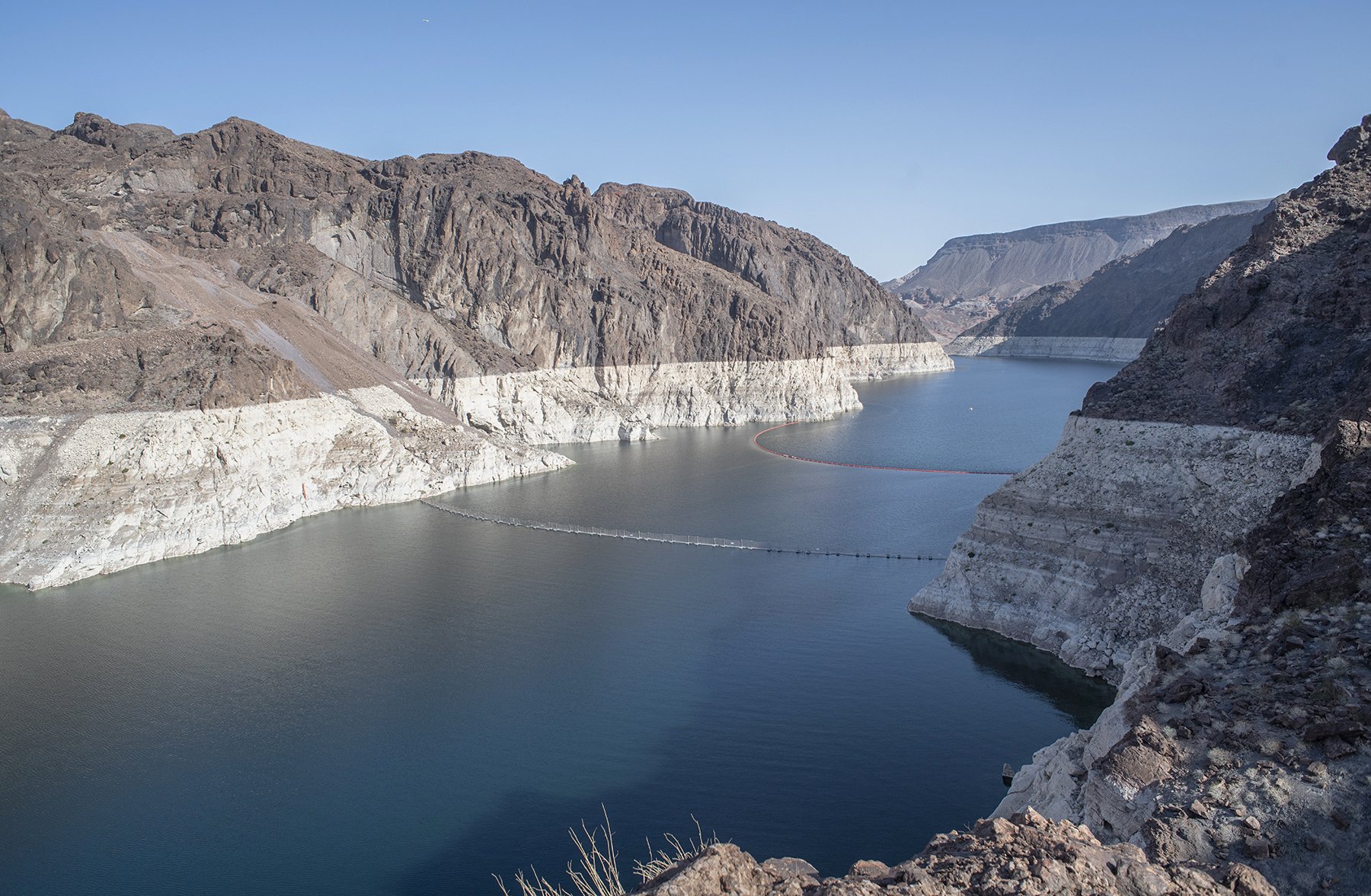
Looking at the drought-depleted Lake Mead upstream of Hoover Dam. The Colorado River is expected to experience record low runoff in 2026.
The Problem
The western U.S. has high variability in precipitation, both annually and within the water year.
As documented by NOAA’s National Centers for Environmental Information, disasters at both wet and dry extremes (floods and droughts) are responsible for billions of dollars in losses.
Being able to predict and plan for extremes and to store water when available benefits local communities, agriculture, energy production, and the environment.

What is S2S?
Subseasonal to seasonal (S2S) forecasts are forecasts that extend beyond a short-term weather forecast (forecasts made 10 days to two weeks in advance). The Weather Research and Forecasting Innovation Act (Public Law 115-25), defines subseasonal as two weeks to three months and seasonal as three months to two years.
Short-term weather forecasts are made by taking initial conditions in place at the beginning of the forecast and predicting the evolution of those conditions. Weather forecasts can have usable skill out to five to seven days in advance, where skill means the ability of a forecast to perform better than simply predicting historical conditions for the period. S2S forecasts rely heavily on boundary conditions rather than the initial state of the atmosphere and presently have little skill
Importance for Water Management
Lead time is critical in making water management decisions and few such decisions are made within the time period of a short-term weather forecast. The most impactful and expensive decisions are made at far longer lead times. Improving precipitation forecasting at longer lead times is essential for helping water agencies manage the extremes of droughts and floods.
Reliable forecasts with longer lead times would allow water managers to operate infrastructure more efficiently and allocate resources to mitigate and manage impacts. Improved forecasts would allow operators to retain more water in storage while still providing flood protection – the equivalent of developing new water supplies at minimal cost.
In dry years water agencies need lead time to implement conservation programs to preserve critical reservoir storage. A 2015 National Weather Service assessment of its performance during one of California’s droughts pointed out that numerous stakeholders called for better seasonal precipitation forecasting.
Remarks of Representative Zoe Lofgren at March 6, 2024 hearing of the Environment Subcommittee of the House Science, Space, and Technology Committee
Water Management Tools
Reliable S2S forecasts would additionally support expansion of new water management tools currently being pioneered with only short-term weather forecasts, such as forecast-informed reservoir operations (FIRO) and flood-managed aquifer recharge (FLOODMar). By allowing for more efficient management of water infrastructure, S2S forecasts would also be a low-cost strategy for assisting climate change adaptation.

S2S Forecasting Now
The National Weather Service’s Climate Prediction Center (CPC) has issued S2S precipitation outlooks since the mid-1990s. However, forecast skill for the western U.S. is limited – just slightly better than predicting average weather conditions – and is not adequate to support water management decision-making. Forecasting precipitation at S2S timescales is scientifically challenging and has historically received little federal research support.
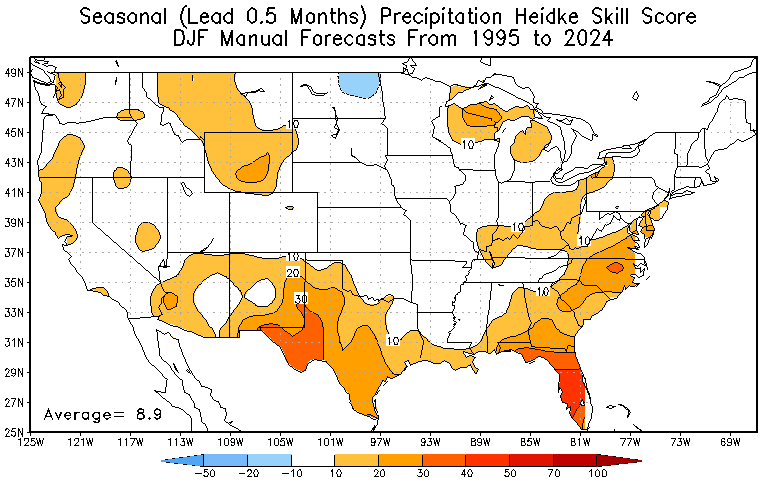
The CPC map above summarizes the historical skill of its outlooks for the December – February period important for western water supply. The Heidke skill score measures the performance of forecasts. A zero score means no more skill than predicting average historical conditions; a perfect forecast would have a score of one. The seasonal outlooks can be dramatically wrong, as illustrated by these 2016 and 2023 examples. The 2016 miss occurred during one of the strongest El Niño events of record; 2023 was an important year for western water management when prolonged extreme drought in many areas flipped to flooding. One reason for poor performance is the lack of scientific understanding regarding the actual influence of the El Niño-Southern Oscillation in much of the country, such as in California and the Upper Colorado River Basin. As illustrated by this information from the Western Regional Climate Center , there is great variability in the influence of ENSO on precipitation in different areas.
More information on CPC outlooks and their verification can be found on CPC websites.
Water Year 2016
Categorical Precipitation Official Forecast Issued November 2015 Valid Dec-Jan-Feb 2016
Categorical Precipitation Observations Valid Dec-Jan-Feb 2015-2016
Water Year 2023
Categorical Precipitation Official Forecast Issued Feb 2023, Valid Mar-Apr-May 2023
Categorical Precipitation Observation Valid March-April-May 2023

Improving Forecasting
Public Law 115-25 directed NOAA to improve its S2S forecasts and to submit a report to Congress with recommendation for doing so. This 2020 report recommended several regional pilot projects chosen based on the existence of major climate phenomena that have huge economic impacts and for which current S2S predictive skill is too low to be effectively used by many stakeholders. They were also chosen because the limited predictive skill of the climate phenomena highlighted for these regions is due to fundamental limitations in our current understanding and models. Therefore, improving predictive skill for these projects would improve skill for other regions as well.
One of the recommended pilot projects is for winter precipitation in the western U.S. to support water management. It would be patterned after NOAA’s successful Hurricane Forecast Improvement Program and would entail implementation and evaluation of model improvements, product development, provision of high-performance computing resources, and academic research. Although recommended in 2020, NOAA has not sought funding for any of the pilot projects via the president’s budget request to Congress. There is broad support for a $15 million increase in NOAA’s budget to begin work on the western precipitation pilot project. As Congress continues to work on reauthorization of Public Law 115-25, support has been expressed for adding the two precipitation forecasting pilot projects recommended in NOAA’s report to Congress to statute. Sustained research funding is needed to improve broad regional-scale NOAA modeling over the western and central U.S., in an effort similar to NOAA’s successful Hurricane Forecasting Improvement Project. Foundational improvement to large-scale modeling will enable subsequent refinement of precipitation forecasting at local scales.
Additionally, two National Academy of Sciences reports provide a long-term road map for making progress on S2S forecasting. The 2016 report expressed a vision that S2S forecasts could be as widely used a decade from now as conventional weather forecasts if the necessary actions were carried out.
Bills have been introduced to reauthorize Public Law 115-25, the Weather Research and Forecasting Innovation Act of 2017, in the 119th Congress. H.R.5089 and S. 3923 both contain language directing NOAA to improve S2S precipitation forecasting and to carry out pilot projects.

Background Materials
Media articles and water agency information
The Hill opinion by Representative Grace Napolitano
Colorado Climate Center blog post on Colorado River water supply forecast error
Public Policy Institute of California blog post
Santa Rosa Press Democrat article
S2S Research Supported by California Department of Water Resources
Presentations from Western States Water Council S2S Workshops
Contact the S2S Coalition
The Subseasonal to Seasonal (S2S) Precipitation Forecasting Coalition is comprised of water users; water management agencies; and a diverse group of local, state, regional, and national organizations committed to advancing improved S2S forecasting in the west and throughout the U.S. Please contact us with questions or for additional information on how to support our efforts.